
Highlights

₹9,039 cr into Small Cap funds, a record, with Mid Cap also at a record ₹7,835 cr
11 of 13 equity categories recorded inflows, against 9 in August, as Large Cap returned to inflow
₹1.72 lakh cr withdrawn from five short-end debt categories, with Liquid alone at ₹95,743 cr
Industry flows and AUM
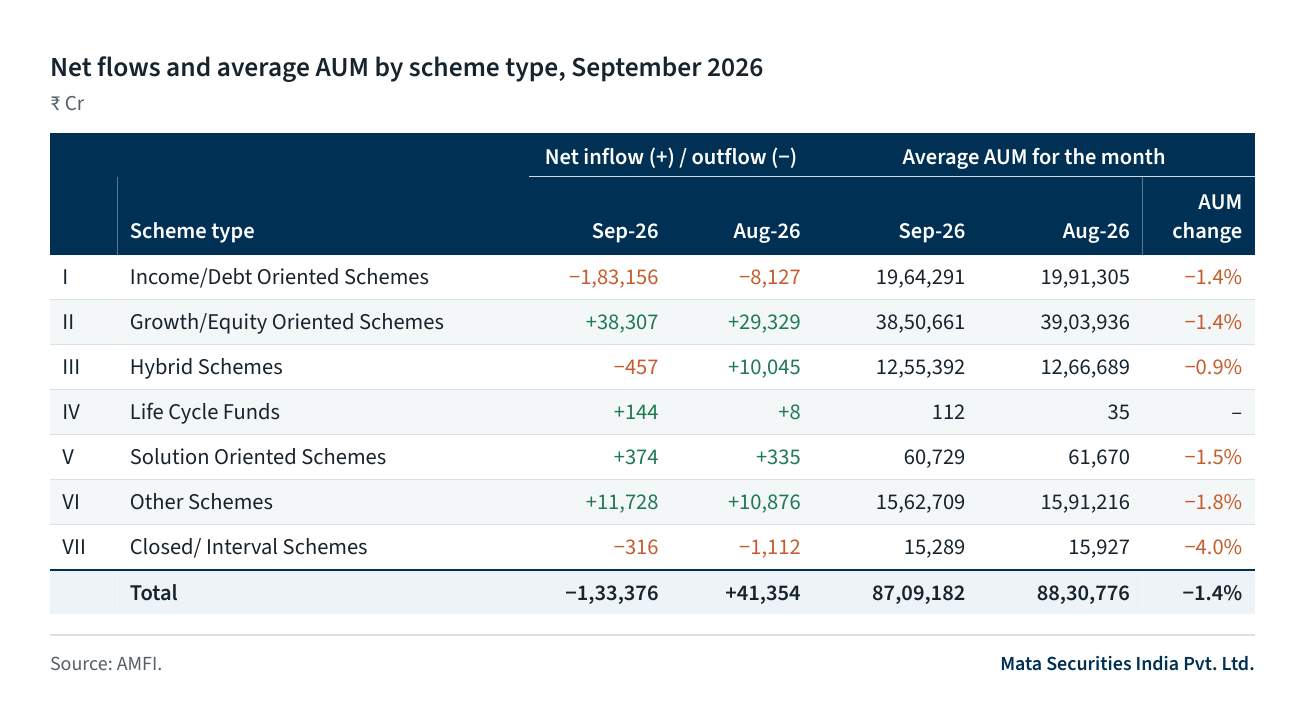
The Mutual Fund industry recorded a net outflow of ₹1.33 lakh cr in September, against a net inflow of ₹41,354 cr in August. Quarter-end advance tax payments and half-yearly balance-sheet requirements led to withdrawals of ₹1.72 lakh cr from short-end debt funds. Month-end Net AUM fell 5.1% to ₹82.64 lakh cr and Average AUM eased 1.4% to ₹87.09 lakh cr. Market-related valuation changes accounted for approximately 70% of the ₹4.44 lakh cr decline in Net AUM, after adjusting for net outflows of ₹1.33 lakh cr, as the Nifty 50 fell 6.1% during the month.
Equity funds
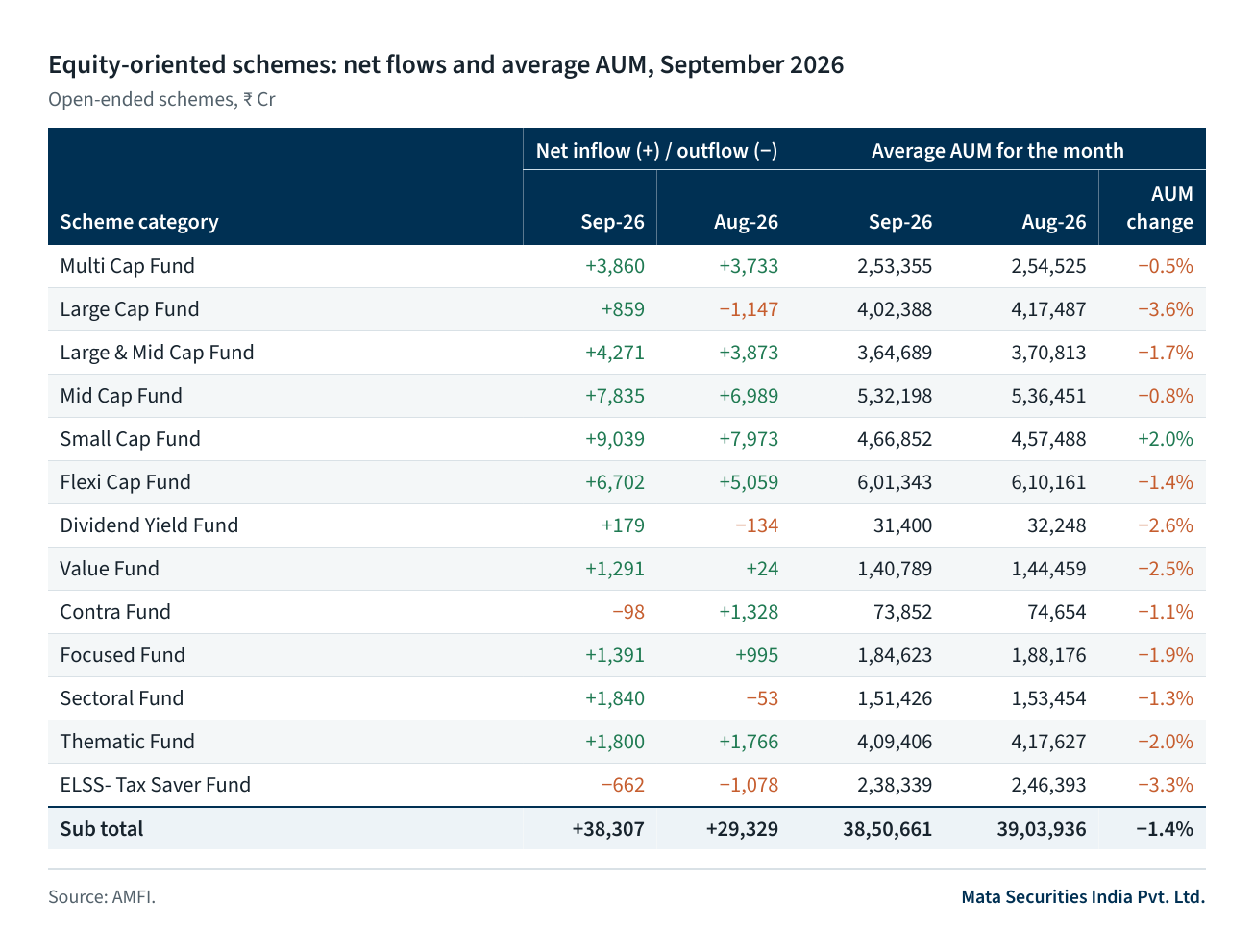
Inflows rose on lower redemptions. Equity net inflows rose 30.6% to ₹38,307 cr, a five-month high. Gross purchases rose only 1.7% to ₹74,832 cr, while redemptions fell 17.5% to ₹36,525 cr. Investors held their positions through a 6.1% fall in the Nifty 50, while steady fresh purchases show continued buying on declines.
The growth was organic. NFOs raised only ₹998 cr across five equity schemes, against ₹3,051 cr in August. Ex-NFO equity flows rose 42% to ₹37,309 cr. In August, roughly half the gain came from NFOs.
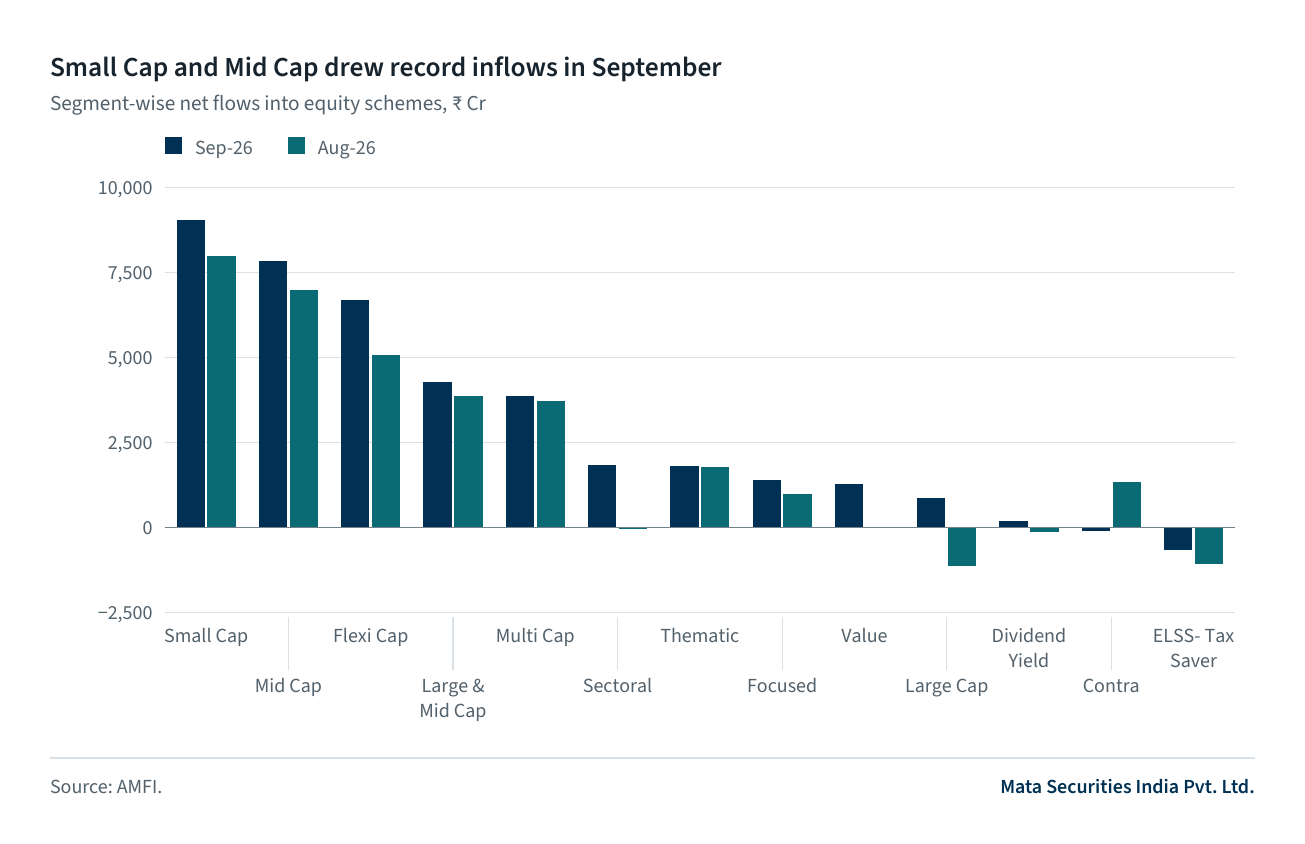
Small Cap and Mid Cap funds set new highs. Small Cap and Mid Cap both drew record monthly inflows, of ₹9,039 cr and ₹7,835 cr respectively. Flexi Cap drew ₹6,702 cr. The Smallcap 250 is up 24.6% in H1FY27 against 1.3% for the Nifty 50. Flows are concentrated in the best-performing and most richly valued segment, which raises concentration risk.
More categories drew money. 11 of 13 equity categories recorded inflows, against 9 in August. Large Cap returned to inflow (₹859 cr) after two months of outflows, with the Nifty 50 down 14.4% in 2026 so far. The Small + Mid share of equity flows fell to 44% from 51%, while Large Cap funds returned to positive inflows, suggesting an early indication of improving investor interest in large-cap allocations.
Sectoral funds recovered. Sectoral and Thematic funds together drew ₹3,640 cr, more than double August’s ₹1,713 cr. Sectoral funds drove the improvement, swinging to an inflow of ₹1,840 cr from an outflow of ₹53 cr. Existing schemes contributed ₹1,437 cr of this, and the Invesco India Pharma and Healthcare NFO added ₹403 cr. Thematic inflows held steady at ₹1,800 cr. Investors appear to be selectively adding sector exposure during the correction, and the pharma NFO points to some interest in defensive sectors.
Debt funds
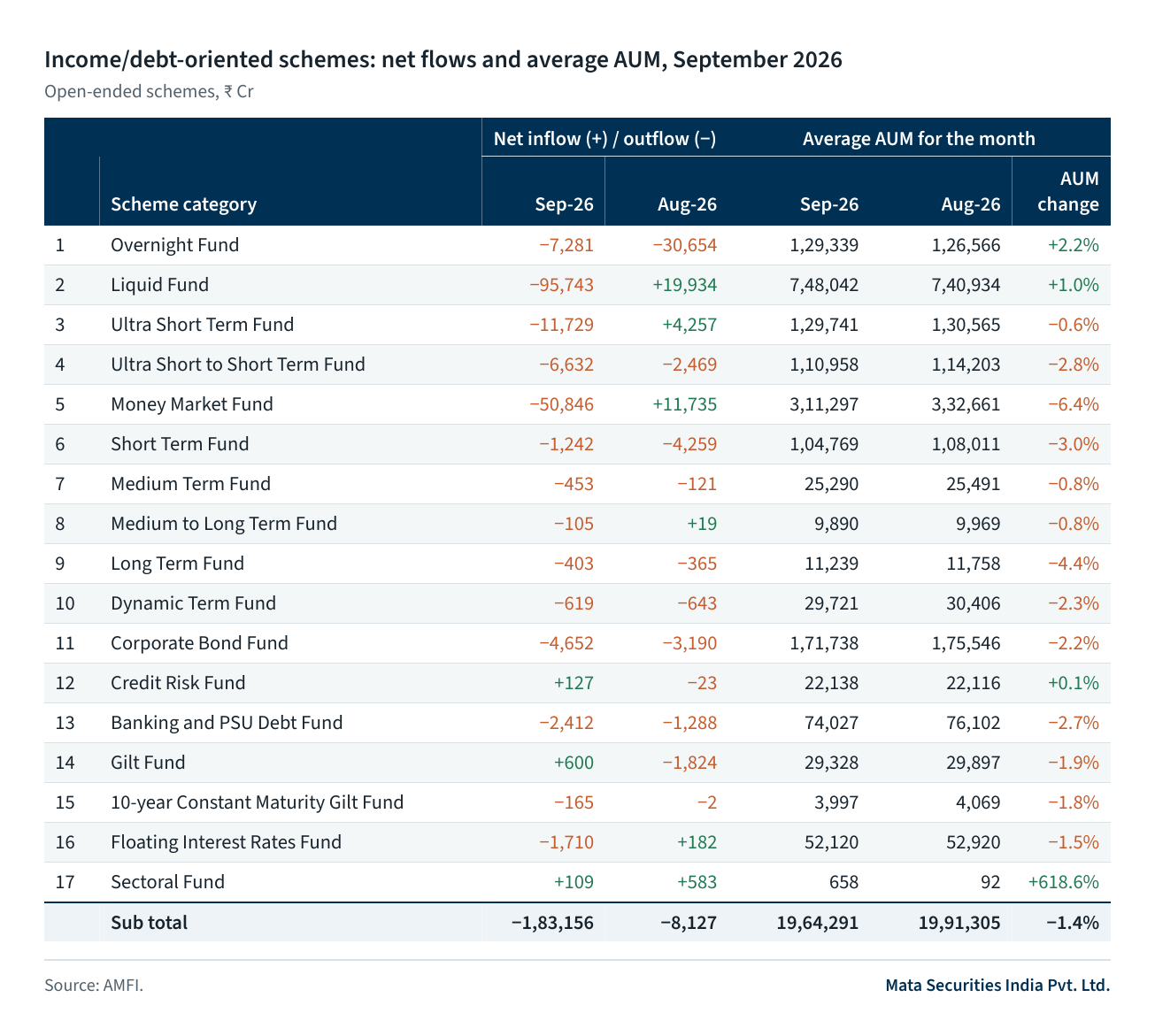
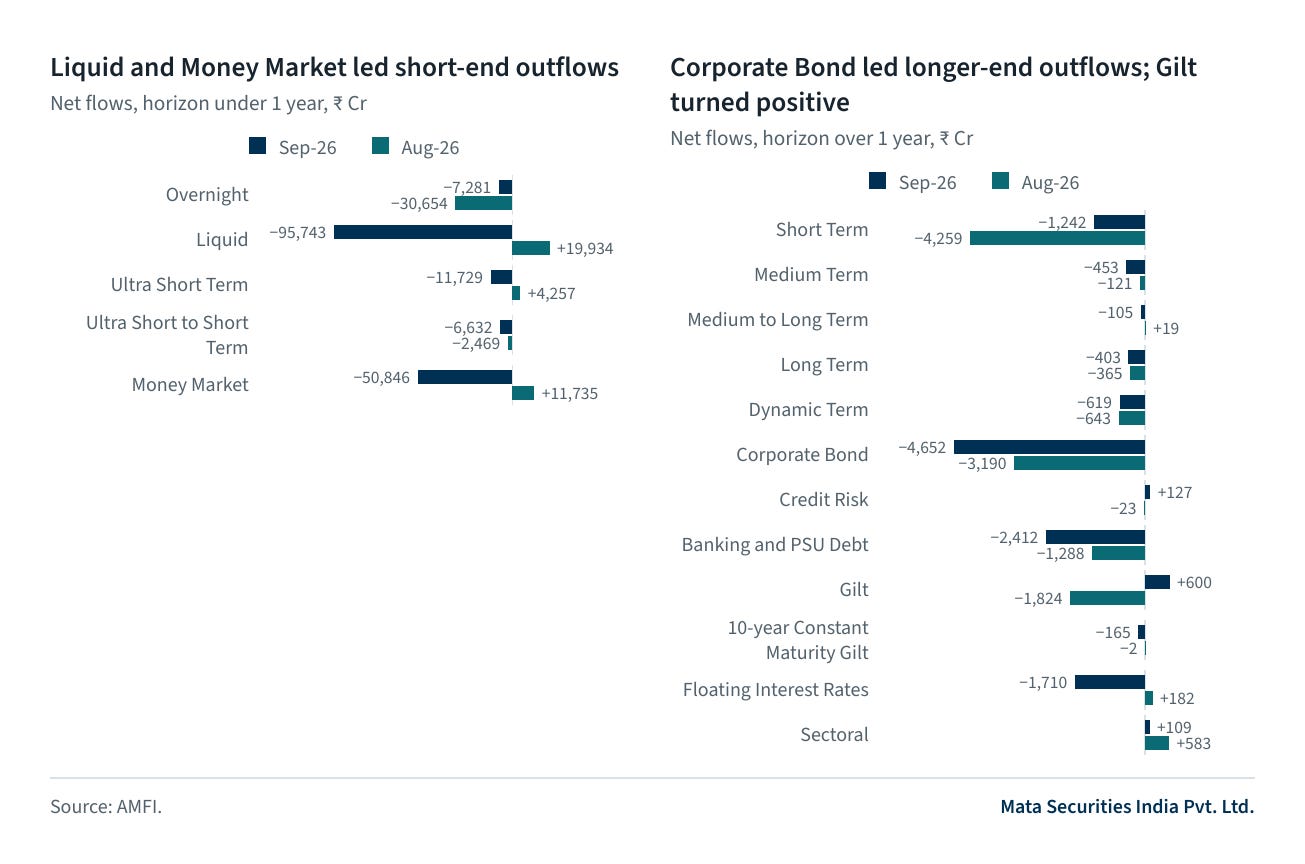
Short-end funds drove the outflow. Debt schemes saw a net outflow of ₹1.83 lakh cr, against ₹8,127 cr in August. Five short-end categories accounted for ₹1.72 lakh cr (94%):
Liquid: ₹95,743 cr
Money Market: ₹50,846 cr
Ultra Short: ₹11,729 cr
Overnight: ₹7,281 cr
Ultra Short to Short: ₹6,632 cr
The pattern is seasonal: corporates and banks withdraw at quarter-end to meet tax payments.
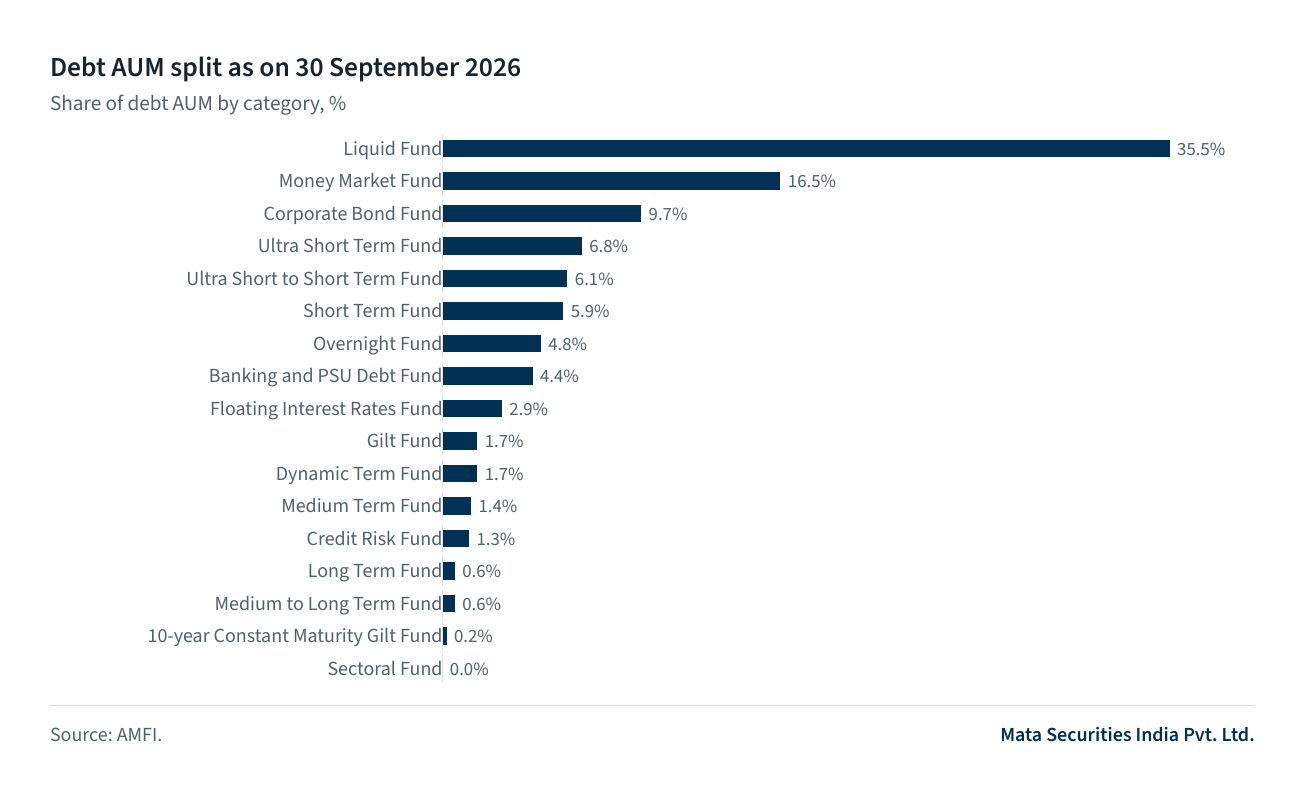
Average AUM understates the outflow. Debt Average AUM eased only 1.4% to ₹19.64 lakh cr. Withdrawals were concentrated in the second half of the month, around the advance tax date and quarter-end, so balances stayed high for most of September. Liquid Average AUM rose 1.0% and Overnight rose 2.2% despite net outflows. Money Market saw the sharpest decline in the group, at 6.4%.
Duration and credit funds continued to see steady outflows. Other debt categories, excluding the five short-end categories and Sectoral Funds, recorded a combined net outflow of ₹11,034 cr, compared with ₹11,514 cr in August. The largest outflows were Corporate Bond at ₹4,652 cr, Banking & PSU at ₹2,412 cr and Floater at ₹1,710 cr. Average AUM declined across the longer end: Long Term −4.4%, Banking & PSU −2.7%, Dynamic −2.3% and Corporate Bond −2.2%. These declines reflect both outflows and mark-to-market losses, as the 10-year G-sec yield rose 24 bps to 7.19%.
Gilt funds turned positive. They drew an inflow of ₹600 cr, against an outflow of ₹1,824 cr in August, suggesting selective positioning at higher yields. Their Average AUM still fell 1.9% because of mark-to-market losses. Credit Risk was the only other duration category in inflow, at ₹127 cr.
The RBI decision supports last month’s caution. On 7 October, the RBI raised the repo rate by 25 bps to 5.50% and changed its stance to “calibrated tightening”. It projects CPI inflation at 6.0% in Q3FY27. There is limited case for adding duration until the inflation trajectory peaks. Short-end accrual strategies now offer higher reinvestment yields.
Hybrid funds and passive funds
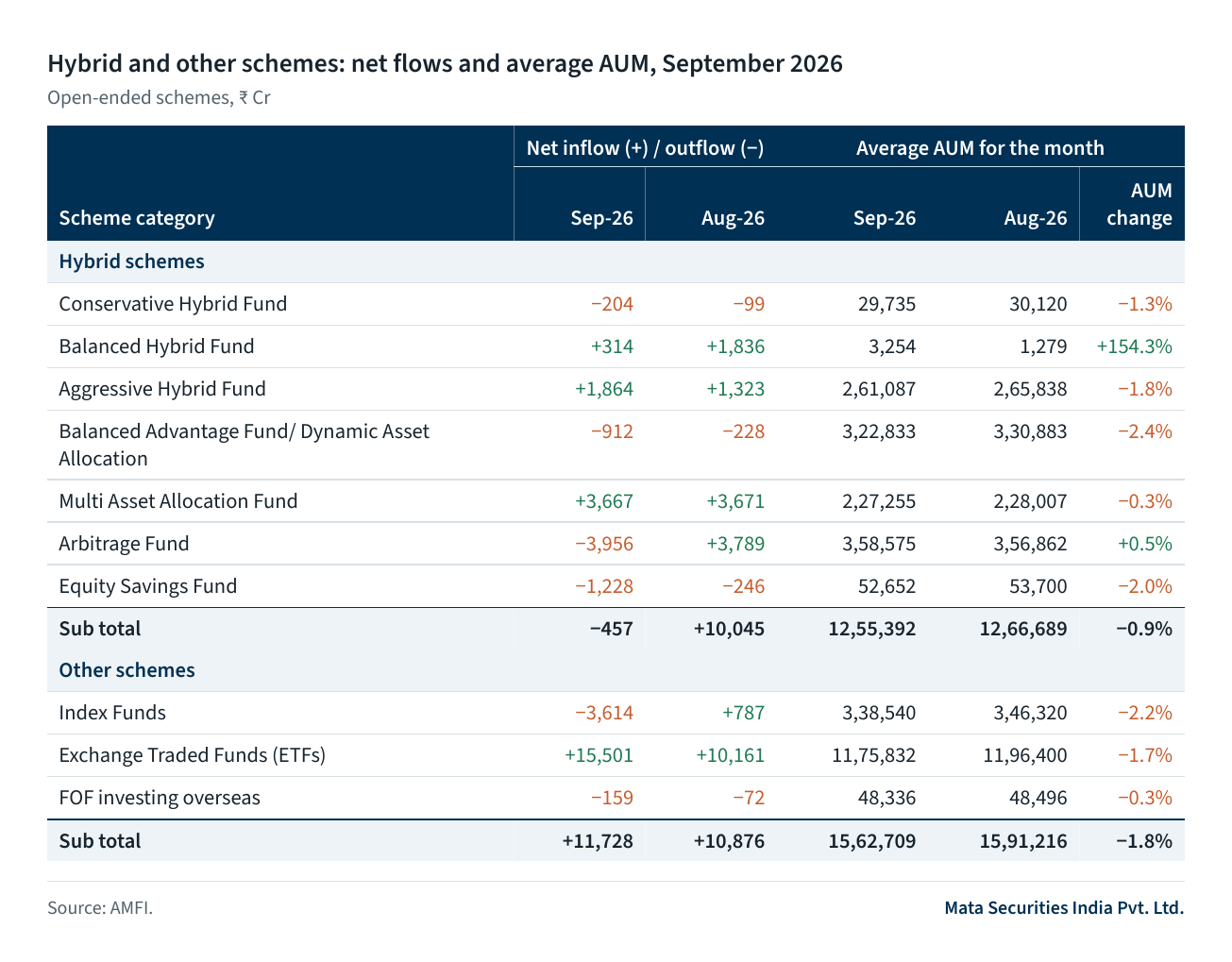
Hybrid recorded its first net outflow since March 2026. The outflow was ₹457 cr, against an inflow of ₹10,045 cr in August. Hybrid Average AUM eased 0.9% to ₹12.55 lakh cr.
Arbitrage funds drove the reversal. They recorded an outflow of ₹3,956 cr, against an inflow of ₹3,789 cr in August. This repeats the quarter-end pattern seen in March 2026 (−₹21,114 cr), as corporate treasuries withdraw funds for advance tax. Arbitrage Average AUM still rose 0.5%, because the withdrawals came late in the month. Excluding arbitrage, hybrid inflows were ₹3,499 cr, against ₹6,256 cr in August.
Multi Asset and Aggressive Hybrid funds remained the preferred choices. Multi Asset Allocation drew a steady inflow of ₹3,667 cr, around ₹3,700 cr for a third consecutive month. Aggressive Hybrid inflows rose 41% to ₹1,864 cr.
Balanced Hybrid inflows were partly from an NFO. The category drew ₹314 cr, including ₹157 cr from the UTI Balanced Hybrid Fund NFO.
Other schemes rose modestly. They drew ₹11,728 cr, against ₹10,876 cr in August, while Average AUM eased 1.8% to ₹15.63 lakh cr. ETFs drove the increase, with inflows rising to ₹15,501 cr from ₹10,161 cr.
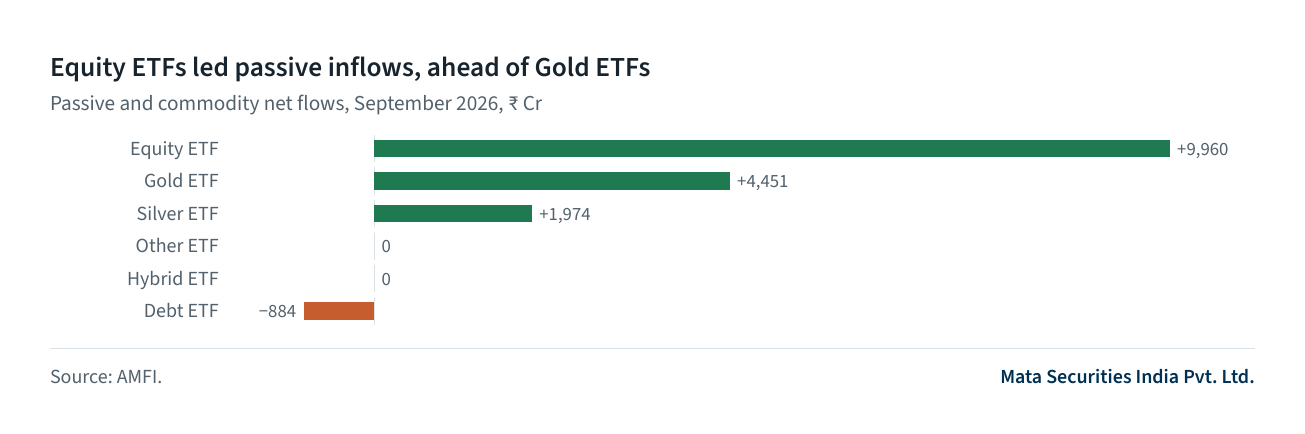
Equity, Debt and Hybrid ETFs: Equity ETFs drew ₹9,960 cr, up 37.6% from ₹7,237 cr in August and about 64% of total ETF inflows. Passive equity buying increased during the correction, in line with the trend in active equity funds. Debt ETFs recorded an outflow of ₹884 cr, against an outflow of ₹945 cr in August, consistent with the cautious stance on duration. Hybrid ETFs saw no flows during the month.
Index Funds: Index funds recorded a net outflow of ₹3,614 cr, against an inflow of ₹787 cr in August, driven primarily by ₹6,258 cr of withdrawals from Debt Index Funds. Equity Index Funds, however, attracted ₹2,649 cr, indicating continued interest in passive equity strategies. Equity ETFs attracted a substantially larger ₹9,960 cr.
Gold and Silver ETFs attracted strong inflows. Gold ETFs drew ₹4,451 cr, up 71% from ₹2,597 cr and the highest since February. Silver ETFs drew ₹1,974 cr, up 55% from ₹1,271 cr. Investors continued to add precious metals as a hedge against geopolitical risk. Other ETFs saw negligible flows.
Overseas Fund of Funds: The outflow widened slightly to ₹159 cr from ₹72 cr, and Average AUM was nearly unchanged at −0.3%. Investor interest in overseas allocation remains limited.
SIP flows
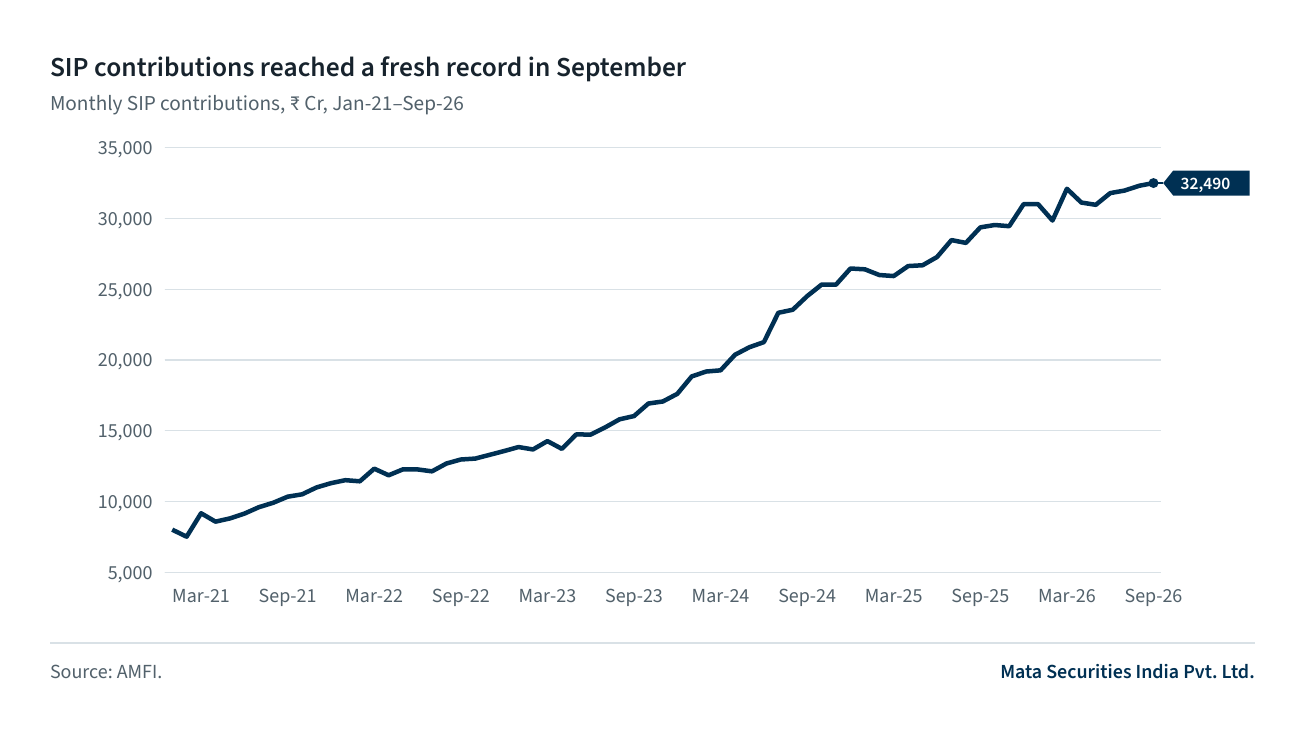
SIP flows: SIP contributions reached a fresh record of ₹32,490 cr in September, up 0.6% from ₹32,297 cr in August and 10.7% higher than a year ago. The record came in a month when the Nifty 50 fell 6.1%, showing that SIP investors stayed invested through the correction. The steady SIP book continues to support domestic mutual fund inflows, strengthening the domestic investor base and helping cushion the impact of persistent FPI selling.
Disclaimer: This report and any recommendation contained herein may not be applicable to the specific investment objectives of the recipient of this report. This should not be used in substitution for the exercise of independent judgment. The information contained in this document has been obtained from sources believed reliable but we do not represent that it is accurate or complete.
SEBI Research Analyst Reg. No. INH000022668 | SEBI Reg. No. INZ000264636 | NSE TM ID 06071 | BSE TM ID 0954 | AMFI Reg. No. ARN-0158 | CIN- U67120MH1993PTC071842 | GST- 27AAACM4228M1ZB